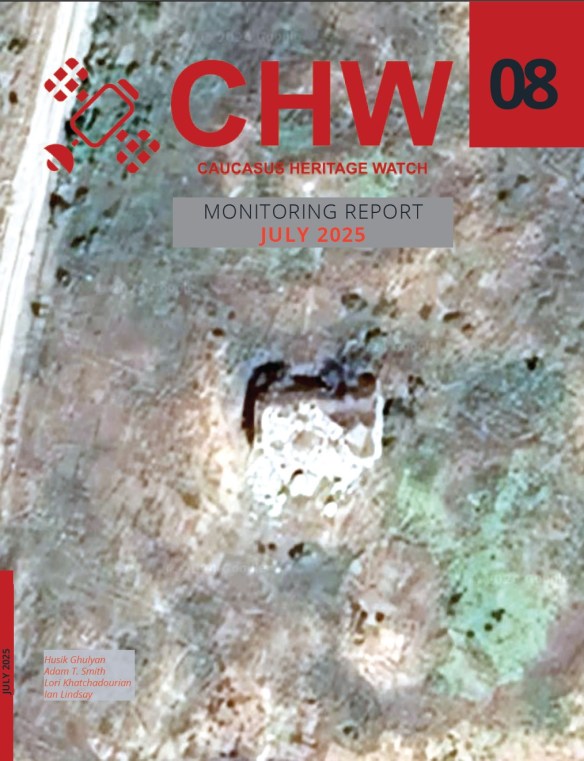
On July 21, 2025, we released our 8th report on Armenian cultural heritage in Nagorno-Karabakh region. The report documents the results of two rounds of satellite-based monitoring (Fall 2024, Spring 2025) of over 500 cultural heritage sites in the region.
On June 5, 2025, as the lead researcher at Caucasus Heritage Watch (CHW), I testified before the U.S. Commission on International Religious Freedom (USCIRF) regarding religious freedom conditions in Azerbaijan. I presented CHW’s monitoring and documentation of threats and abuses against Armenian cultural heritage in the Karabakh region, highlighting their implications for religious freedom in the country.
The full video of the hearing can be found below:
More details on the USCIRF hearing can be found here.
Nation in Motion: Relational Spaces of Modern Armenia Since the 19th Century
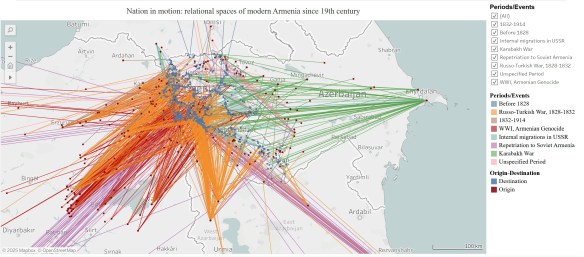
The goal of this project, completed in February 2020 under the title Nation in Motion: Relational Spaces of Modern Armenia Since the 19th Century, was to map the origins of populations in the settlements of modern Armenia and analyze the dynamics of population migration, resettlement, and displacement resulting from major historical events.
The dataset compiled for the project encompasses population movements since the 19th century, addressing significant events such as the Russo-Turkish War, the Armenian Genocide, Soviet-era resettlements, repatriation to the Armenian SSR, and the First Karabakh War.
Utilizing this dataset, I developed an interactive map using Tableau, which is available to explore [here].
The map’s filter view, categorized by historical periods and events, facilitates a deeper understanding of population flows into modern Armenia’s territory during various historical contexts.
The dataset, its scope, limitations, and sources are available under the CC-BY-4.0 license on Open Science Framework [here].
The dataset as well as the interactive map have not been updated since February 2020.

 Differential Space*